Process Manager
The Process Manager keeps long-running commands active for a website. cPGuard X uses PM2 for process management, but the feature is not limited to Node.js applications.
Use the Process Manager for services that must continue running after you close the terminal or leave the page.
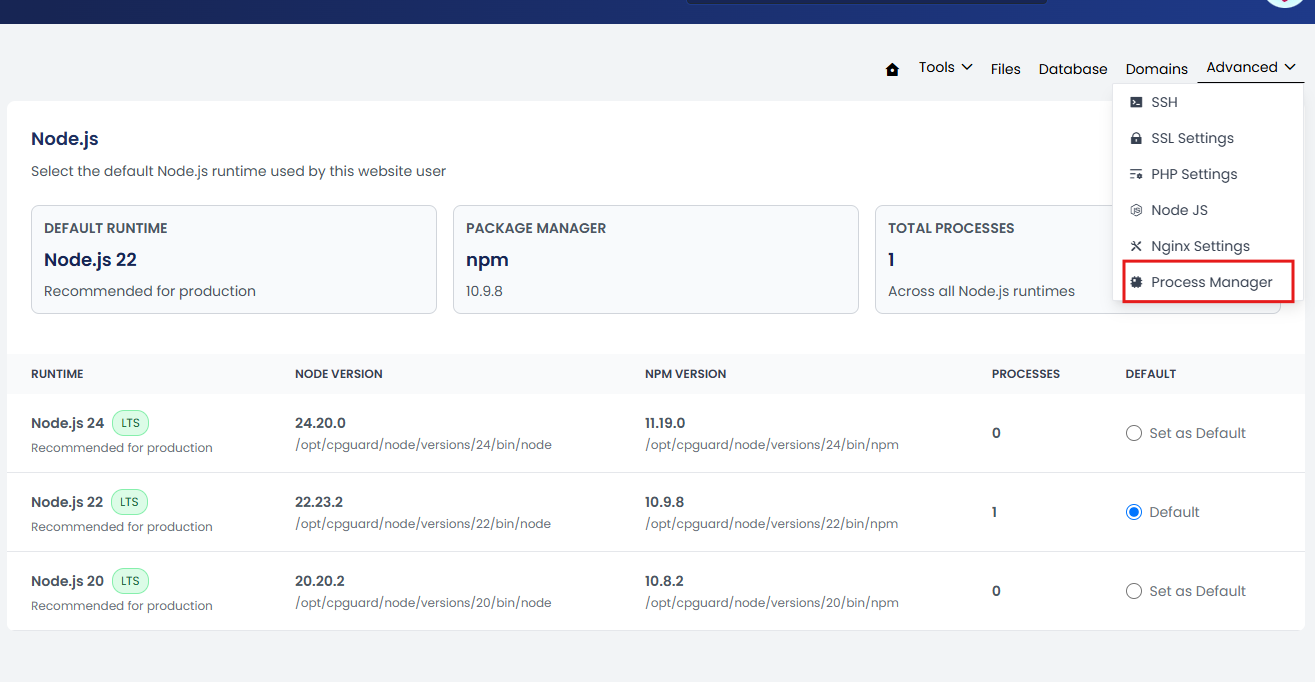
Process Manager is available from:
Website Management → Advanced → Process Manager
Overview
The Process Manager displays the processes configured for the website, along with details such as the process name, command, status, running time, PID, CPU and memory usage, listening port, and available process actions.
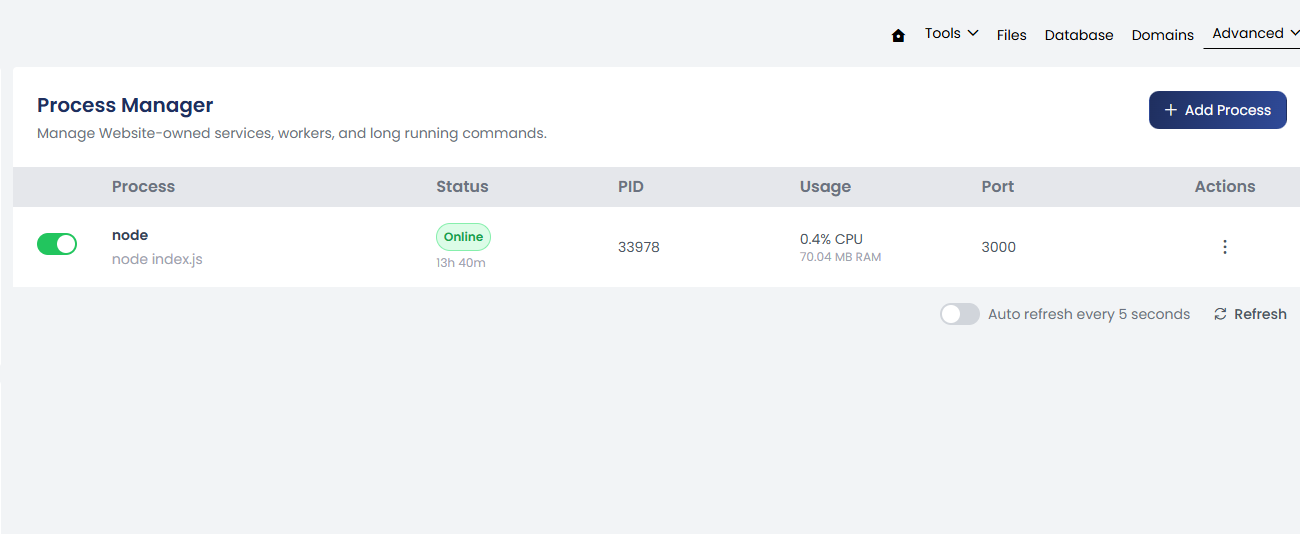
The process list is automatically refreshed periodically.
Add a Process
Click + Add Process to create a supervised process.
The Add Process form contains the following options.
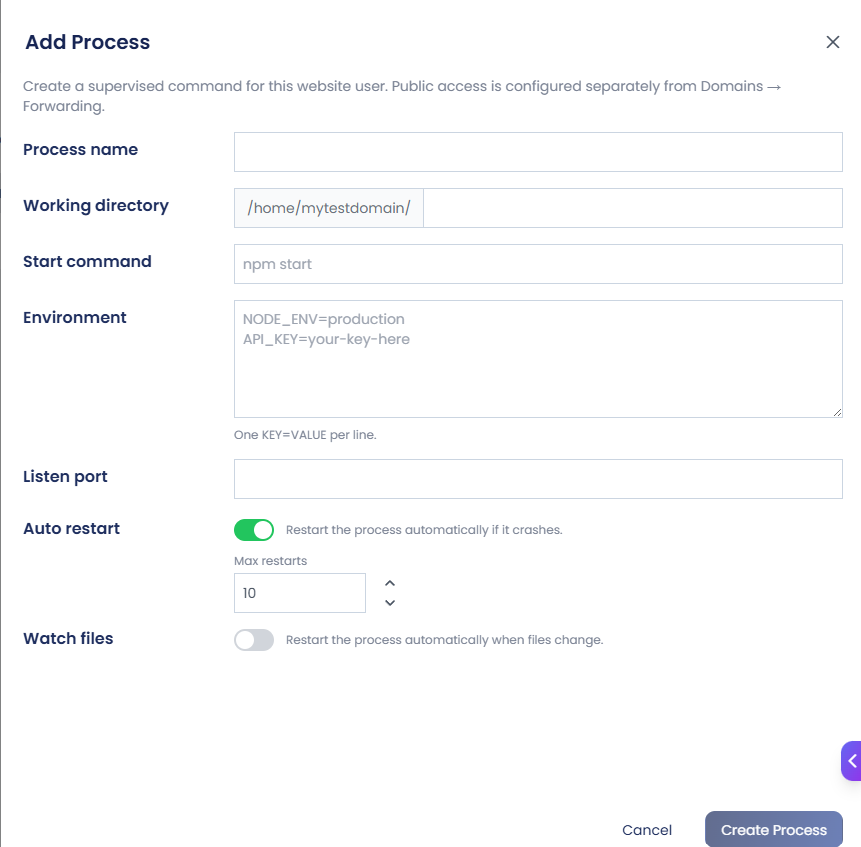
Process Name
Enter a descriptive name that helps identify the process.
Example:
node-app
Working Directory
Specify the directory from which the process should run.
Example:
/home/username/node-app/
The working directory should contain the application or files required by the start command.
Start Command
Specify the command used to start the application or service.
Examples:
node index.js
or:
npm start
The command should match the application's configuration.
Environment
Add environment variables required by the application or service.
Use one variable per line:
KEY=VALUE
For example:
NODE_ENV=production
PORT=3000
Environment variables allow applications to receive configuration without hard-coding those values in the application source.
Listen Port
Specify the port on which the application or service listens.
For example:
3000
The configured port should match the port used by the application.
If the application listens on:
127.0.0.1:3000
the Process Manager configuration should use port:
3000
This port can then be used as the target port in a Reverse Proxy rule.
Auto Restart
Enable Auto Restart to automatically restart the process if it crashes or exits unexpectedly.
This is useful for long-running services that should remain available without manual intervention.
Max Restarts
Specify the maximum number of automatic restart attempts.
This helps prevent a continuously failing process from being restarted indefinitely.
Watch Files
Enable Watch Files to automatically restart the process when monitored application files change.
This can be useful during development or for applications that require a restart after file changes.
After entering the required information, click Create to create the process.
Managing Processes
After a process is created, it appears in the Process Manager list.
Use the three-dot menu under Actions to manage the process.
Available actions include:
- Restart – Restart the process.
- Edit – Modify the process configuration.
- Delete – Remove the process.
- Error Logs – View errors generated by the process.
- Output Logs – View the standard output generated by the process.
Port Conflicts
Only one process can use the same IP address and port at the same time.
For example:
127.0.0.1:3000
If one process is already using this port, another process cannot start on the same IP and port.
If a port conflict occurs:
- Check which process is already using the port.
- Stop the process if it is no longer required, or
- Configure the new application to use a different port.
- Make sure the Process Manager and Reverse Proxy configurations use the new port.